


Your cart is empty.
Click here to purchase!
Blog
Liver Spots

03/02/2026
14:10
Our bodies are like canvases on which time relentlessly paints its marks. We respond sensitively to environmental changes — just as a carpenter’s hands are worn by wood, or a climber’s skin is often torn by rock, we too are continuously exposed to the effects of the sun. And over the years, these influences accumulate.
The traces of time and sunlight don’t merely tell stories on our hands or faces — they leave visible signs on our skin as well. Among these are the brownish discolorations commonly referred to as liver spots: sun spots and general hyperpigmentation. While they are not dangerous, many people find them aesthetically troubling, prompting an important question: how can we support our skin’s natural defenses — even with the help of dietary supplements?
In today’s article, we explore this very topic and pose the big question: what do so-called “liver spots” really have to do with our liver?
Why do you need to protect yourself from the Sun?
Sunlight is essential for life — without it, there would be no oxygen and no vitamin D — yet it also triggers invisible biochemical processes in the skin that can be harmful in the long run.1 UV radiation has a particularly strong effect on cells: it is one of the main drivers of skin ageing, pigmentation spots, and even cancerous changes.
The “photoaging” process
To understand how hyperpigmentation develops, you need to be familiar with the mechanism of “photoaging” — ageing caused by light.2
Let’s start with the smallest building block: what is light?
Light is electromagnetic radiation with both particle and wave characteristics.3 Its particles are called photons. When radiation from the Sun reaches the skin, it is essentially high-energy photons colliding with the skin’s surface cells.
In reality, things are far more complex, because a photon isn’t truly a “real” particle — but let’s not go there now. The key point is that light can be grouped by wavelength4:
- Infrared (IR, >700 nm): produces the sensation of heat and makes up about 50% of solar radiation.
- Visible light (400–700 nm): what your eyes perceive, accounting for roughly 40% of solar radiation.
- Ultraviolet (UV, 100–400 nm): only about 5–10%, but biologically very significant. It is divided into:
- UVA (320–400 nm): penetrates deeper and accelerates skin ageing.
- UVB (280–320 nm): causes DNA damage in the surface layer, but also triggers vitamin D synthesis.
- UVC (100–280 nm): filtered out by the ozone layer, so it doesn’t reach us. It has strong antimicrobial properties, but is highly cell-damaging; direct skin exposure is prohibited. Certain UV lamps emit this light and are used for sterilisation, water purification, and in laboratories.
- Other radiation:
- X-rays, gamma rays: almost completely absorbed by the atmosphere.
- Radio waves: also present, but biologically less relevant.
All types of radiation mentioned above consist of photons:
- short wavelengths consist of high-energy photons (gamma, X-rays, UV),
- long wavelengths consist of low-energy photons (radio waves, microwaves).
Short-wavelength UV photons carry high energy, which is why they can damage DNA — and trigger oxidative stress. By way of contrast: UVB radiation is a double-edged sword, because while high exposure can be destructive, small amounts are a key regulator of your body’s vitamin D production.
It’s also important to know that your body defends itself against the harmful effects of UV radiation by producing the brown pigment melanin.5 Melanin absorbs and scatters UV photons, protecting DNA from direct damage. The amount and type of melanin determine skin tone and the effectiveness of this defence. That’s why, in countries where sunlight is stronger, people tend to be born with naturally darker skin.
How do age spots form?
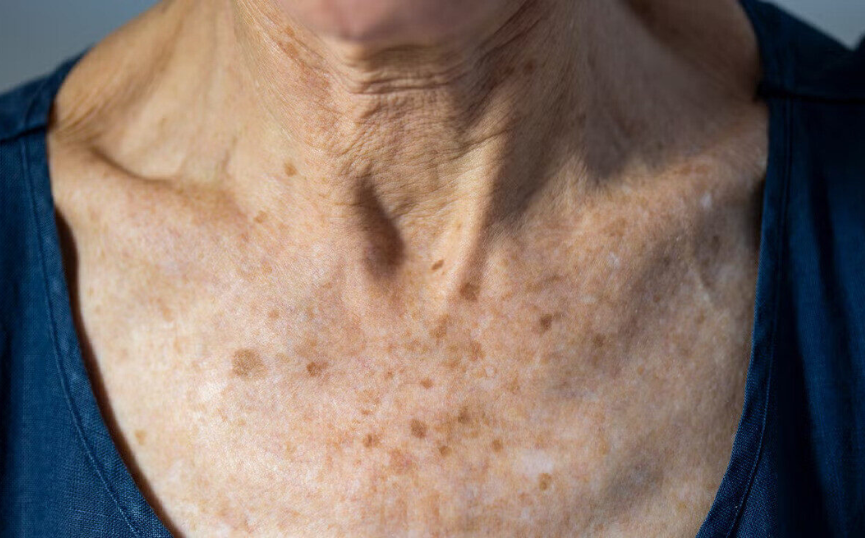
Age spots are the result of excessive melanin accumulation. The “switch” behind them is typically excessive UV exposure (sun exposure and tanning beds), hormonal changes, or genetic predisposition. In other words, an age spot is a benign pigmented skin change that appears mainly on sun-exposed areas (face, backs of the hands, shoulders, arms).6
So age spots have nothing to do with the liver! They are flat, brownish patches with sharp borders. Their size can range from a few millimetres to several centimetres. They do not protrude from the skin and typically cause no discomfort.
“Sun spots” and “age spots” are essentially the same phenomenon; melasma is somewhat different.
Melasma is hormonally driven hyperpigmentation, often developing during pregnancy or due to hormonal therapy.7 These are symmetrical brownish patches affecting only the face — commonly referred to as “pregnancy spots” or the “mask of pregnancy”.
Age spots should not be confused with freckles either, because freckles are genetic.
Back to UV radiation: a key factor in the formation of age spots is the release of reactive oxygen species triggered by UVA radiation.8 These molecules steal electrons from components of healthy skin cells (cell membranes, collagen, and proteins), damaging them. Once cells are injured, an inflammatory response starts — and ultimately leads to local melanin build-up.
How do hormones influence pigmentation?
Why can hormonally driven hyperpigmentation (melasma) develop?
There is a so-called melanocyte-stimulating hormone (MSH) produced by the pituitary gland. Its level rises mainly in response to UV radiation, but hormonal changes can also influence it.7 For example:
- Oestrogen and progesterone increase melanocyte activity, which leads to more melanin production. This is why melasma is common during pregnancy (“pregnancy mask”) and when taking hormonal contraceptives.
- Stress can also increase inflammatory mediators, which may indirectly provoke pigment changes. Interestingly, MSH comes from the same precursor protein as adrenocorticotropic hormone (ACTH). ACTH rises in response to stress, which is why MSH may also increase under stress.
- Overactive or underactive thyroid function can also be associated with pigmentation disorders.
What can you do about age spots/melasma?
Protection against age spots comes down to protection against free radicals. That’s where antioxidants come in: they can donate electrons to damaged cells, helping regeneration. They can also help prevent damage directly.9
Antioxidants act broadly — across all cells. But for skin health, it may be worth supplementing antioxidants that are more specific to epidermal cells and melanocytes (the pigment-producing cells).
The following antioxidants are particularly effective in the skin:
- Vitamin C (ascorbic acid)10-12: widely known for general health support and immune benefits. It participates in many key biochemical processes as a cofactor — meaning your body uses vitamin C to help certain reactions run to completion. One standout effect is its influence on the enzyme tyrosinase, through which vitamin C can directly reduce melanin production. As a skin-specific benefit, it also stimulates collagen synthesis and improves skin regeneration — helping to fade pigmentation while preserving a youthful skin structure.
- Vitamin E (tocopherol)13,14: a fat-soluble antioxidant that integrates into the phospholipid bilayer of cell membranes. Since the membrane is the first line of defence, UV-induced damage often shows up here first. Under oxidative stress, fatty acids can form reactive oxygen species — a process called lipid peroxidation. Vitamin E can help prevent this, protecting membrane stability. It also works synergistically with vitamin C: each enhances the other’s antioxidant effect, strengthening skin protection.
- Niacinamide (vitamin B3)15-17: there’s another key point in age-spot formation. Melanin is produced by melanocytes, but it doesn’t stay there — it is packaged into “sacs” and transferred into keratinocytes, the skin’s main epidermal cells. This is where vitamin B3 (niacinamide) comes in: it can block or reduce the transfer of melanosomes from melanocytes to keratinocytes. The result may be a more even skin tone, fading of dark spots, and prevention of new spots forming.
- Polyphenols (green tea catechins, resveratrol, quercetin)18-20: generally powerful antioxidants with anti-inflammatory effects.
- Coenzyme Q10 (ubiquinone)21: a key cofactor in cellular energy production that also functions as a strong antioxidant. It primarily supports mitochondria — the cell’s “power centres” — helping energy production and neutralising free radicals. In doing so, it contributes to the protection of epidermal cells and the maintenance of overall cellular health.
- Carotenoids (beta-carotene, lycopene, lutein)22,23: particularly effective in the skin and the retina, where they can absorb UV photons and act as an antioxidant shield.
Based on this: Vitamin360’s recommendation
Because supplementation aimed at age spots typically involves higher-dose vitamins, it’s best used periodically. Throughout the year, a basic, balanced multivitamin is usually sufficient — it keeps micronutrients consistently available without pushing doses too high. In summer, however, when the skin faces heavier UV exposure, increasing the intake of certain antioxidants and skin-specific nutrients may be justified.
For year-round use: Now Foods Daily Vits – Multivitamin. Now Foods Daily Vits is a balanced, lower-dose multivitamin that can be taken all year.
In summer, pause Daily Vits and switch to a higher-dose multivitamin: Life Extension Two-Per-Day Multivitamin and Minerals.
In summer, alongside the multivitamin, use:
- Vitamin A: Swanson Beta-Carotene (Vitamin A) (100 Softgels)
- Omega-3, to support the protection of epidermal cell walls: Nutricost Omega-3 2500 mg
- A plant-based antioxidant: Now Foods Natural Resveratrol 200 mg (60 Veg Capsules)
In addition to the four supplements, it may be worth using vitamin E oil topically: Now Foods Vitamin E Oil (118 ml). Use strictly in the evening: apply 1–2 drops directly onto the age spots (upper cheeks, forehead, area above the upper lip, backs of the hands, or décolletage). It is not recommended under sunscreen, because vitamin E oil may increase photosensitivity through oxidation, and the oily layer (created by vitamin E) can reduce sunscreen adherence. That’s another reason to use it at night.
Because this summer supplementation recommendation includes higher-dose antioxidants, it’s best to take it for 3–4 months (from May to September). From autumn, you can return to Daily Vits or choose a more moderate multivitamin.
Ruling out other causes
While dietary supplements can support the body in general, they do not replace proper medical evaluation.
As mentioned earlier, age spots can be influenced not only by external factors, but also by hormonal effects. Identifying these requires regular medical check-ups — and effective management depends on appropriate monitoring and, when necessary, targeted therapy.
Pay attention to your body’s signals and changes. The foundation of managing dermatological issues is early detection: regular skin checks aren’t merely recommended — in practice, they should be considered essential.
Sources ⋙
- D'Orazio J, Jarrett S, Amaro-Ortiz A, Scott T. UV radiation and the skin. Int J Mol Sci. 2013 Jun 7;14(6):12222–48. doi: 10.3390/ijms140612222. PMID: 23749111; PMCID: PMC3709783.
- Hooda R, Madke B, Choudhary A. Photoaging: Reversal of the Oxidative Stress Through Dietary Changes and Plant-Based Products. Cureus. 2023 Apr 9;15(4):e37321. doi: 10.7759/cureus.37321. PMID: 37182009; PMCID: PMC10168638.
- Armstrong FA. Photons in biology. Interface Focus. 2013 Oct 6;3(5):20130039. doi: 10.1098/rsfs.2013.0039. PMCID: PMC3915828.
- https://science.nasa.gov/ems/09_visiblelight/
- Schlessinger DI, Rahimi N, Schlessinger J. Biochemistry, Melanin. [Updated 2025 Jul 14]. In: StatPearls [Internet]. Treasure Island (FL): StatPearls Publishing; 2025 Jan-. Available from: https://www.ncbi.nlm.nih.gov/books/NBK459156/
- Choi W, Yin L, Smuda C, Batzer J, Hearing VJ, Kolbe L. Molecular and histological characterization of age spots. Exp Dermatol. 2017 Mar;26(3):242–248. doi: 10.1111/exd.13203. PMID: 27621222; PMCID: PMC5342934.
- Basit H, Godse KV, Al Aboud AM. Melasma. [Updated 2023 Aug 8]. In: StatPearls [Internet]. Treasure Island (FL): StatPearls Publishing; 2025 Jan-. Available from: https://www.ncbi.nlm.nih.gov/books/NBK459271/
- de Jager TL, Cockrell AE, Du Plessis SS. Ultraviolet Light Induced Generation of Reactive Oxygen Species. Adv Exp Med Biol. 2017;996:15–23. doi: 10.1007/978-3-319-56017-5_2. PMID: 29124687.
- Stone WL, Pham T, Mohiuddin SS. Biochemistry, Antioxidants. [Updated 2023 May 1]. In: StatPearls [Internet]. Treasure Island (FL): StatPearls Publishing; 2025 Jan-. Available from: https://www.ncbi.nlm.nih.gov/books/NBK541064/
- Wang K et al. Role of Vitamin C in Skin Diseases. Front Physiol. 2018;9:819.
- Boo YC. Ascorbic Acid (Vitamin C) as a Cosmeceutical to Increase Dermal Collagen for Skin Antiaging Purposes. Antioxidants. 2022;11(9):1663.
- Sanadi RM, Deshmukh RS. The effect of Vitamin C on melanin pigmentation: A systematic review. J Oral Pathol Microbiol. 2021.
- Fuchs J et al. Effects of oral vitamin E and β-carotene supplementation on ultraviolet radiation–induced oxidative stress in human skin. Am J Clin Nutr. 2004;80(5):1270–1275.
- Mahfoudh M et al. The Epitome of Antioxidants Against UV Photodamage: Vitamin E Use in Skin Protection. J Dermatol Res. 2025;6(2):1–9.
- Hakozaki T et al. The effect of niacinamide on reducing cutaneous pigmentation and suppression of melanosome transfer. Br J Dermatol. 2002;147(1):20–31.
- Oblong J, Matts PJ. A Review of the Range of Effects of Niacinamide in Human Skin. Int J Cosmet Sci. 2010.
- Somboon K et al. Enhancing Niacinamide Skin Penetration via Other Skin Brightening Agents. Int J Mol Sci. 2025;26(4):1555.
- Kumar V et al. Antioxidants for Skin Health. Recent Advances in Food, Nutrition & Agriculture. 2024. PMID: 39108105.
- Tomas M et al. The state of the art in anti-aging: plant-based phytochemicals for skin care. Immun Ageing. 2025;22:5.
- Febrinasari RP et al. Green tea as a cosmetic agent for skin aging: A scoping review. Universitas Sebelas Maret. 2024.
- Lain ET et al. The Role of Coenzyme Q10 in Skin Aging. J Clin Aesthet Dermatol. 2024;17(8):50–55. PMID: 39148958.
- Stahl W, Sies H. β-Carotene and other carotenoids in protection from sunlight. Am J Clin Nutr. 2012;96(5):1179S–1184S.
- Grether-Beck S et al. Oral supplementation with lycopene or lutein protects skin against UV radiation. Br J Dermatol. 2017;176(5):1231–1240.

Among our articles written by our nutrition expert, you'll find product reviews and helpful tips on healthy living and prevention.
Our most popular articles:
